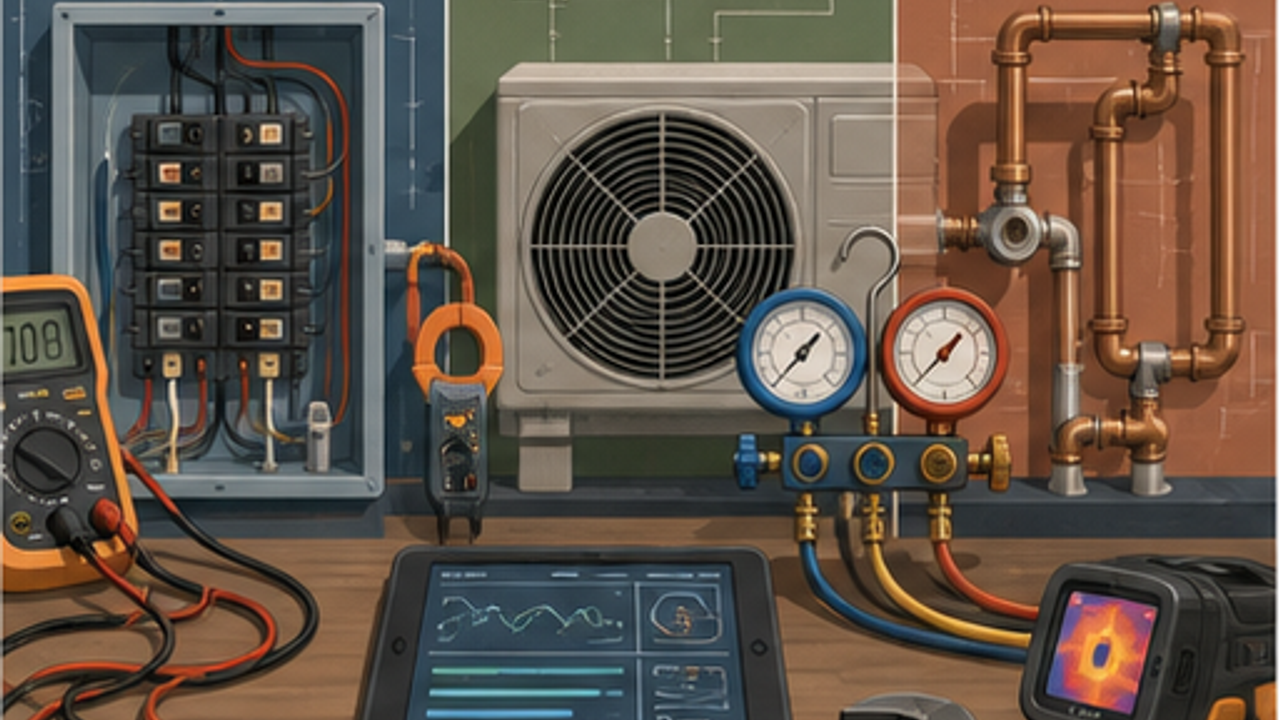
Systems trades are attractive to readers who like solving problems. Electrical, HVAC, plumbing, refrigeration, solar and low-voltage paths all include moments where the worker has to trace a symptom back to a cause. That can be satisfying. It can also be frustrating when the first explanation is wrong, the customer is waiting, access is poor or safety limits prevent a beginner from touching what they want to understand.
The fit question is not simply whether the reader likes technical work. It is whether they can stay careful when information is incomplete. A system can fail for more than one reason. A visible symptom can point toward the wrong part of the job. A rushed guess can become expensive or unsafe. Good systems work rewards method, documentation and humility.
Diagnosis changes the pace of the day
A project-based installation may move through layout, rough-in, testing, inspection habits and finish coordination. A service situation may begin with a complaint, a symptom, a customer story or a failure that has already interrupted somebody’s day. Both can be systems work, but they feel different. Installation rewards sequence and preparation. Service rewards listening, testing and deciding what not to assume.
A beginner should observe both if possible. Someone may enjoy clean project sequence but dislike urgent troubleshooting. Another person may enjoy short diagnostic loops and dislike long project dependencies. The trade title alone will not reveal that preference.
Higher score means the pressure tends to appear earlier for a beginner.
- Incomplete information88
- Safety boundary82
- Customer explanation70
- Visible finish pressure46
Uncertainty is part of the work
Uncertainty does not mean guessing. It means building a habit of checking. What changed? What is the symptom? What is known? What is unsafe to touch? What can be tested under supervision? What evidence would prove the first idea wrong? These questions matter more than sounding confident early.
Systems trades also require tolerance for invisible work. A roof, wall, pipe run, panel, duct, device, controller or fixture may hide the actual cause. The worker may need to slow down, document conditions and explain why a simple-looking issue is not simple. That is a different pressure from finish work, where defects may be visible immediately.
Fit signals to watch
- You like tracing a problem in steps rather than jumping to the answer.
- You can admit uncertainty without giving up responsibility.
- You respect safety boundaries even when curiosity is high.
- You can explain technical uncertainty to a nontechnical person.
Safety and scope come before confidence
Systems work can involve hazards that beginners should not treat casually. Electricity, pressure, combustion, refrigerant, water damage, confined spaces and roof or attic access can all change what a beginner should do alone. The right entry route should teach what to observe, what to ask and what not to touch without authorization or supervision.
Responsible diagnostic observation
State the symptom
Write what is observable before naming a cause.
Mark the boundary
Separate safe observation from work requiring supervision or authorization.
Ask for the test
Notice what evidence an experienced worker uses to confirm or reject a theory.
Record the lesson
Keep the takeaway as a process note, not a shortcut.
A beginner can use this sequence for observation and supervised learning.
How to test the fit without pretending to be licensed
The reader does not need to perform regulated work to learn about fit. They can observe service calls, compare training routes, ask workers what beginners misunderstand, study tool categories and write down what kinds of symptoms interest them. The goal is not to become competent from a distance. The goal is to decide whether the learning curve is worth entering responsibly.
A strong systems choice has a real first route, patience with testing, respect for boundaries and interest in the cause behind the symptom. A weak choice depends mostly on the status of a technical title. If the diagnostic process itself is not interesting, the path may become frustrating after the first attraction fades.
End with three questions: Do I want to solve uncertain problems repeatedly? Can I stay careful when I am not yet allowed to touch the risky part? Can I learn from a slower sequence before expecting speed? If the answer is yes, systems trades deserve deeper comparison.
If the answer is mixed, choose the next observation carefully. Watch one service-style problem and one installation-style sequence. Do not judge only the trade title. Notice how the experienced worker gathers information, explains risk, stages tools and decides when the first theory is wrong. That behavior is the real preview of systems work. A reader who enjoys that process may have a stronger signal than someone who only likes the idea of a technical label.
One more useful test is note quality. After watching a systems task, write down the symptom, the suspected causes, the safe checks, the unsafe boundaries and the final explanation. If the notes become clearer with each observation, the path is teaching the reader how to think. If the notes stay vague because only the tool or title was interesting, the reader needs a different kind of exposure. Systems work rewards curiosity, but only when curiosity becomes a controlled method.